Coffee has been a great power in my life;
History has observed its effects on a monumental scale. Some claim coffee inspires them, while some claim it only makes boring people even more boring. Some have conjectured that coffee sets the blood in motion and stimulates the muscles; Some claim it accelerates the digestive processes, chases away any sleep, while giving us the chance to involve ourselves a little longer in the exercise of our intellects. I say the moment caffeine enters your stomach, and flares are shot up to the brain; from that moment on, everything becomes agitated. The ‘logic’ artillery rushes up with clattering wagons and ammunition; the ‘metaphor’ cavalry is deployed with a spectacular gallop; the sharpshooters sight and fire at the ‘imaginations’ command.
Enough with the fables and the legends.
What is Caffeine?
Chemically, caffeine is a member of the Methylxanthine Alkaloid family and is known as 1,3,7-trimethyl xanthine. Alkaloids are interesting natural chemicals that include at least one nitrogen molecule. Caffeine looks like a white powder when separated, but don’t let that deceive you—it tastes quite bitter.
Caffeine Consumption: A Global Perspective
One of the few fitness-related subjects where the general public shares, if not surpasses, the enthusiasm of fitness fanatics is caffeine. Since everyone might use a morning energy boost and caffeinated beverages like tea and coffee play a significant role in many cultures, interest from non-lifters is natural. According to some estimates, the consumption of caffeine in India is estimated at 91,000 tonnes in 2023. The average daily caffeine intake of Indian adults is around 98 mg to 232.9 mg, and about 44% of them drink a caffeinated beverage regularly1. Although that may seem excessive, the average daily consumption of caffeine in Finland and Sweden is more than 400 mg2.
I wouldn’t dare interfere with the morning caffeine fix, but we shouldn’t ignore caffeine’s possible negative qualities simply because we like its best qualities, especially after the two recent lawsuits that linked the intake of a specific caffeinated product at an American restaurant chain to fatal cardiac arrhythmias.
How Caffeine Works: The Double-Agent Effect
In our body, caffeine acts like a double agent inside our blood vessels. The lining of your blood vessels (called the vascular endothelium) relies on clear chemical signals to decide whether to open up (relax) or tighten up (constrict). Caffeine sends mixed messages to this system at the exact same time. Very cool and weird right?
So, to keep blood flowing smoothly, endothelial cells release a chemical called nitric oxide (NO), which tells the blood vessels to relax and widen. Caffeine is the gas pedal and the brake pedal for Nitric Oxide. What?
The Gas Pedal (Vasodilation) effect:
Firstly, caffeine causes calcium to be released from storage inside endothelial cells (via ryanodine receptors). This increase in intracellular calcium activates an enzyme called endothelial Nitric Oxide Synthase (eNOS). As a result, eNOS speeds up the production of nitric oxide, signaling the blood vessel walls to relax and widen.3
The Brake Pedal (Vasoconstriction) effect:
Simultaneously, caffeine acts as an adenosine receptor antagonist, meaning it blocks adenosine from binding to its natural receptors (called A2a receptors) on the vessel lining. Normally, adenosine binding to these receptors triggers a cascade that keeps eNOS active and produces NO. But by blocking these receptors, caffeine shuts down this signal, suppressing baseline NO production and thus causes our blood vessels to constrict.3
Therefore, by caffeine hitting both the “gas pedal” (stimulation) and the “brake” (inhibition) on nitric oxide, your blood vessels can react differently depending on how much caffeine you consume or your baseline blood pressure.
cGMP:
Another cool phenomenon that happens is nitric oxide uses a helper chemical inside the cell called cGMP which signals the blood vessels to relax.3
Think of cGMP as a team of little vigilante police inside the cell. These cGMP police tell the muscle cell to lock up the calcium that keeps the muscle tight. Without calcium to stay squeezed, the muscle relaxes. The blood vessel opens up wider, blood flows smoothly, and your blood pressure goes down. (Medicines like Viagra or nitroglycerin use this exact pathway.)
Normally, the body quickly breaks cGMP down so blood vessels do not stay expanded forever. But, caffeine blocks the enzymes that clean up cGMP. By preventing cGMP from breaking down, caffeine forces this “relax” signal to stick around longer than it usually would.
Because caffeine is triggering all these opposing reactions at once, your body experiences a tug-of-war:
- The Narrowing Effect: Caffeine triggers the sympathetic nervous system (fight-or-flight) and can directly shrink the inside space (lumen) of blood vessels, which makes arteries stiffer and raises blood pressure temporarily.3
- The Widening Effect: Simultaneously, the boost in nitric oxide production and the preserved cGMP levels work to keep the vessels relaxed and open.3
Caffeine creates conflicting signals. Some pathways try to relax your blood vessels while others try to constrict them. Which mechanism “wins” often depends on caffeine dosage, individual sensitivity, and whether blood pressure is elevated at the time.
Clinical Research: Gray et al Study
Next, we take a look at Gray et al4, which looked at the Cardiovascular effects of caffeinated energy drinks in familial Long QT Syndrome, so let’s jump in and see what they found.
Purpose
The study aimed to determine the acute cardiovascular effects of consuming caffeinated energy drinks in patients diagnosed with familial Long QT Syndrome (LQTS), specifically evaluating potential risks in dangerous heart rhythms (QTc prolongation) and blood pressure changes.
Subjects & Methods
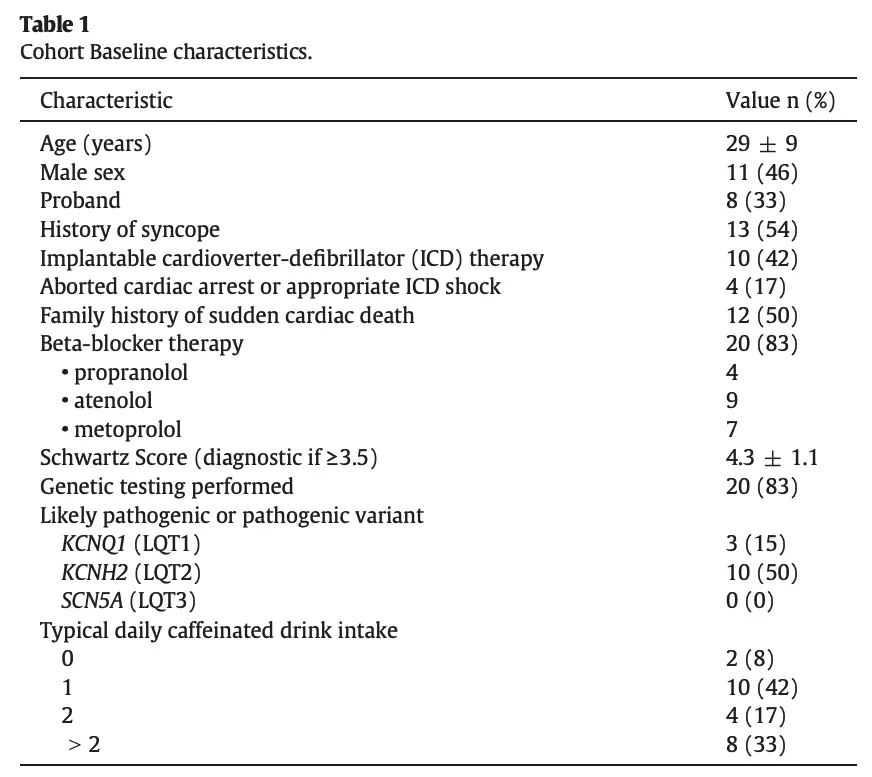
The researchers studied 24 patients with confirmed LQTS (aged 16–50 years; 54% female; mean age 29±9 years). Most participants (83%) were taking beta-blockers, and 58% were symptomatic prior to diagnosis. This was a randomized, double-blind, crossover trial where patients acted as their own controls, separated by at least a 1-week washout period. Participants fasted from caffeine for 48 hours and alcohol for 24 hours prior to testing.
Intervention:
- Two cans of sugar-free Red Bull which has 160 mg caffeine and 2000mg taurine in 500mL.
- A placebo cordial-based drink without caffeine or taurine (500ml).
These beverages were administered in two equal portions at 0 minutes and 30 minutes. Over a total observation window of 90 minutes, researchers recorded serial 12-lead electrocardiograms (ECGs) and blood pressure every 10 minutes, alongside signal-averaged ECGs (SAECG) and blood draws for serum caffeine and taurine assays every 30 minutes.
Participant characteristics are presented in Table 1.
Findings
- There were no statistically significant group-level differences detected in QTc prolongation between the energy drink session and control session (maximum mean change was 16±27 ms vs. 12±28 ms, representing a 4% vs. 3% increase, p=0.71).
- The proportion of patients who experienced a QTc increase of ≥ 20 ms was statistically indistinguishable between the energy drink and control arms (38% vs. 33%, p = 1.0).
- Baseline heart rates were identical between arms, and heart rate fluctuations remained equivalent (7% change in both arms, p=0.94). No ventricular arrhythmias, cardiac symptoms, or late potentials on SAECG occurred during the 90-minute testing window.
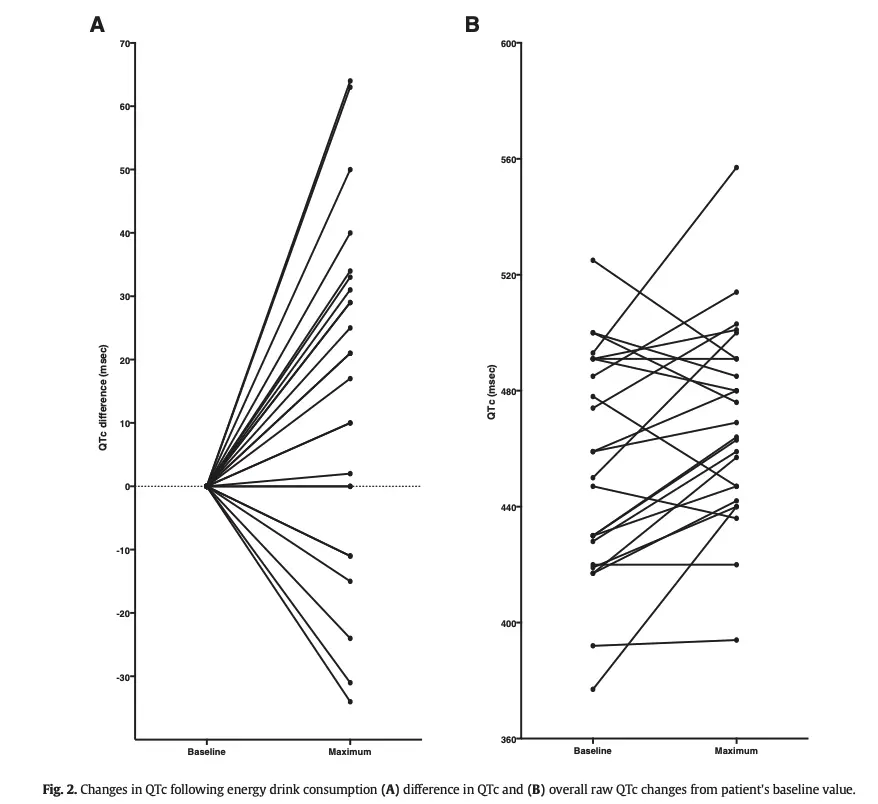
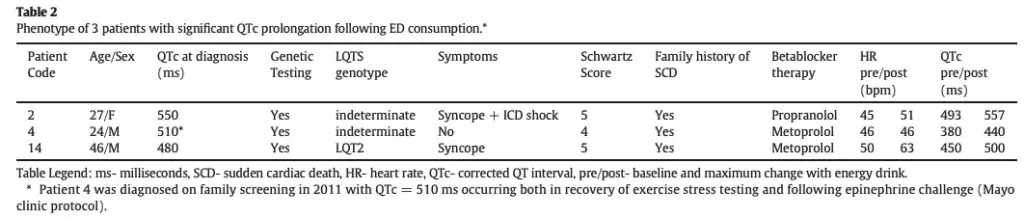
Interestingly, despite non-significant average group data, 3 individual patients exhibited dangerous QTc prolongations of ≥50 ms after consuming the energy drink:
- Patient 2: A 27-year-old female taking propranolol with an ICD and prior syncope/shocks experienced a 64 ms jump in QTc (from 493 ms at baseline to 557 ms at 90 minutes).
- Patient 4: A 24-year-old male on metoprolol expanded his QTc by 60 ms (from 380 ms to 440 ms).
- Patient 14: A 46-year-old male with LQT2 taking metoprolol prolonged his QTc by 50 ms (from 450 ms to 500 ms).
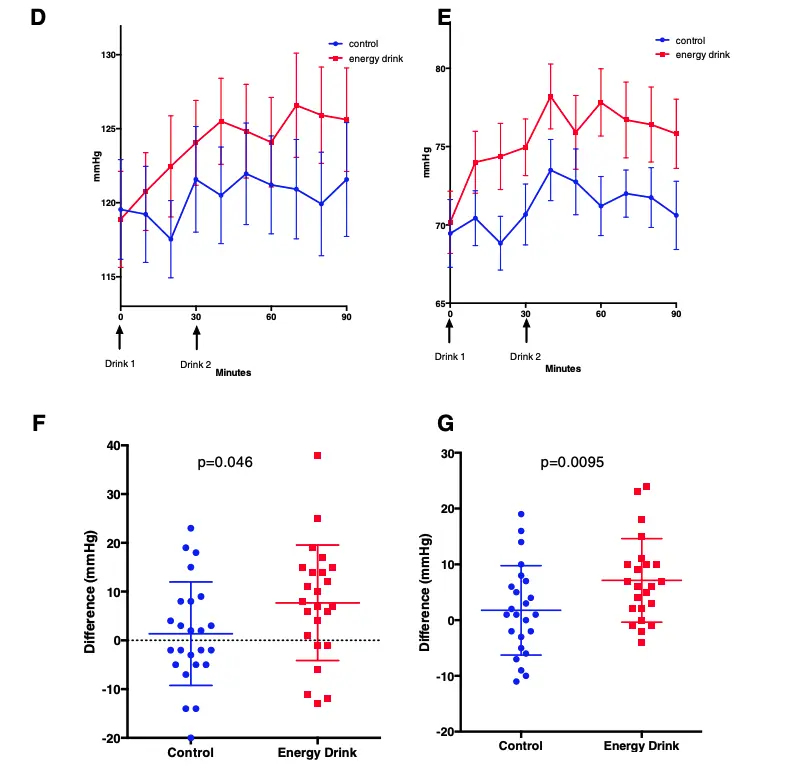
The changes in blood pressure were interesting. Energy drink consumption produced a statistically significant surge in peak SBP compared to placebo (7±16 mmHg vs. 1±16 mmHg, a 6% rise vs. 0.8%, p=0.046), reaching maximum separation at 70 minutes. Diastolic Blood Pressure peaked at 60 minutes with a significant jump compared to control (8±10 mmHg vs.2±09 mmHg, an 11% rise vs. 3%, p=0.01). Hemodynamic spikes tracked directly with metabolic absorption, as serum caffeine levels rose from 3.5 mu mol/L to 14.6 mu mol/L (p<0.001) and serum taurine rose from -59 mu mol/L to 737 mu mol/L (p<0.001). Figures D & E show the systolic and diastolic blood pressure changes, and Figures F & G show peak systolic and diastolic blood pressure changes during the study.
Interpretations
One thing is clear from this study: People with LQTS should definitely avoid caffeine.
Energy drinks trigger rapid cardiovascular changes in patients with LQTS, as shown by the acute systemic blood pressure spikes. Sudden elevations in the systemic vascular resistance increase cardiac workload and can serve as an unexpected layer for not-so-good cardiovascular events.
While population-wide mean data does suggest energy drinks do not cause uniform QTc prolongation across all mild LQTS cases, people with severe underlying disease markers (e.g., higher baseline QTc, previous fainting spells, or strong family histories of sudden cardiac death) still remain highly susceptible to dangerous electrical delays.
A huge limitation in this study was the persistent usage of prescribed beta-blockers among 83% of the study subjects which likely attenuated sympathetic stimulation, blunts down blood pressure spikes, and potential ventricular arrhythmias. Unmedicated individuals or those consuming higher energy drink volumes may face exponentially greater risks.
The Svatikova et al. Study
In another randomized, double-blind, placebo-controlled crossover study by Svatikova et al.5, we saw a similar effect of caffeinated energy drinks on acute resting blood pressure and massive sympathetic nervous system activation in 25 healthy, unmedicated, nonsmoking young adults.
The most striking outcome was a 73.6% increase in plasma norepinephrine (the primary hormone of the “fight-or-flight” system) after energy drink consumption, compared to a baseline 30.9% increase with placebo.
Within 30 minutes, the caffeinated energy drink also produced significant increases in blood pressure at rest.
An interesting point to note from this study is that the heart rate increased modestly in both arms without a statistically significant difference (p=0.45). This shows that the observed blood pressure rise is driven by increased vascular resistance (vasoconstriction) via norepinephrine, rather than an increased cardiac output/pumping rate, which was usually considered the reason.
Another interesting finding was that although the caffeinated energy drink did shift the baseline blood pressure upward, it did not exaggerate or multiply the additional blood pressure changes caused by subsequent physical, mental, or cold stressors.
Personal Anecdote
I would also like to share a personal anecdote here. For the past 4-5 years, I had been consuming caffeinated beverages (upwards of 500 mg caffeine) daily, and due to some interference with my medication, I had to quit caffeine cold turkey for 6 months. My observations from that time have been quite interesting. First of all, I have chronically suffered from a panic attack disorder, and I noticed a dramatic reduction in my attacks. I also observed that I would feel the need to sleep more – at first glance this might seem too obvious to be insightful, but I came to realize that I had been undersleeping way more than I had realized, and caffeine would cover up my sleep like a Band-Aid.
I won’t make the ostentatious claim that giving up caffeine will transform your life or that it’s the one secret trick big caffeine doesn’t want you to know, much to the dismay of the powerful marketing machine that controls everything I do. But I’d like you to consider the following questions:
- Do you feel better after using caffeine, or does it help you avoid negative emotions that caffeine causes in the first place, like headaches and drowsiness?
- Are you truly getting enough sleep, or are the symptoms of inadequate sleep being covered up by caffeine?
- Do you have any predispositions that make you doubt your present caffeine intake, such as anxiety, sleep problems, arrhythmias, or a family history of heart conditions?
Summary: Key Takeaways
To summarize the evidence, people with LQTS should definitely avoid energy drinks and high caffeine intake. Also, caffeinated energy drinks cause rapid increases in systemic blood pressure, raising vascular resistance and putting extra stress on the heart. We also see that caffeinated energy drinks trigger a big jump in the body’s main “fight-or-flight” hormone (norepinephrine) within 30 minutes. Another point to note was that the blood pressure rise from caffeine is due to norepinephrine squeezing blood vessels (vasoconstriction), not because the heart pumps faster.
Now, caffeine is not inherently harmful, and to be honest most people won’t see any significant improvements in their performance, well-being, or health if they cut back from two daily cups to none at all. However, if you have been diagnosed with a heart problem (or are concerned that you may have an undiagnosed heart condition), you should consult a healthcare provider to fully investigate the problem and decide on the right amount of caffeine to consume. It may be time to ask yourself the questions outlined in this article to see if a caffeine-free experiment is worthwhile if you’re having problems that could be related to caffeine (such as arrhythmias, anxiety, etc.) or if your daily caffeine intake is just getting out of control.
My 2 Cents
Surprisingly enough, we still have a lot to learn about caffeine—especially since critical study limitations, such as the usage of beta-blockers among participants, modest energy drink dosing (160mg caffeine), a short 90-minute monitoring window, small sample sizes (I would like to see upwards of 100), and a cohort composed mostly of mild cases, which most likely blunted blood pressure spikes and masked the full cardiovascular risks in unmedicated or higher-risk individuals.
I’d also like to see more experimental research on how different caffeine doses and timing strategies impact blood pressure, as well as how we can explain differing subjective experiences, particularly when study design constraints and concurrent medications haze the true picture. I’m very interested in finding out if these conflicting impacts on cardiovascular health and subjective sensitivity are related to the rate of caffeine metabolism, habituation among daily consumers, inaccurate self-assessments, or maybe it is something else entirely.
Works Cited
- CRISIL Limited. Coffee Consumption Trends in India, 2023. Coffee Board of India, Ministry of Commerce and Industry, 2023.
- Fredholm BB, Bättig K, Holmén J, Nehlig A, Zvartau EE. Actions of caffeine in the brain with special reference to factors that contribute to its widespread use. Pharmacol Rev. 1999 Mar;51(1):83-133. PMID: 10049999.
- Higashi Y. Coffee and Endothelial Function: A Coffee Paradox? Nutrients. 2019 Sep 4;11(9):2104. doi: 10.3390/nu11092104. PMID: 31487926; PMCID: PMC6770186.
- Gray B, Ingles J, Medi C, Driscoll T, Semsarian C. Cardiovascular Effects of Energy Drinks in Familial Long QT Syndrome: A Randomized Cross-Over Study. Int J Cardiol. 2017 Mar 15;231:150-154. doi: 10.1016/j.ijcard.2016.12.019. PMID: 28189188.
- Somers KR, Svatikova A. Cardiovascular and Autonomic Responses to Energy Drinks-Clinical Implications. J Clin Med. 2020 Feb 5;9(2):431. doi: 10.3390/jcm9020431. PMID: 32033367; PMCID: PMC7073550.