



I’ve been wondering whether or not to post about this HMB controversy for a few days. While attempting to uphold the ideal of charity, I’m quick to point out notions that are dubious or blatantly incorrect, but I try to refrain from making personal judgments until I have all the information and am certain that the individuals in issue are spouting irrationality. This is partly due to me disliking conflict, but it’s also because I don’t want to be hypocritical and I expect the same decency.
Now that the ambiguous introduction has moved out the way, let’s get to the meat & potatoes: HMB, Is it Anti-catabolic or Anabolic?
Every few years, HMB goes through the same cycle. A bunch of early studies generates excitement, supplement companies pile in, and lifters end up buying tubs expecting steroidal gains.
They feel nothing dramatic, post an angry review, and move on. Then a new wave of researchers publishes meta-analyses, and debates start flaring up about whether HMB “works,” and the whole thing repeats.
Now the problem with it: Everyone evaluates HMB on the wrong metric.
People ask, does HMB build lean muscle strength? That’s like saying: Why aren’t fire extinguishers good at lighting fires?
It completely misses the point.
The right question (the one evidence supports) is:
Can HMB stop your muscle from being destroyed when your body is under stress?
And the answer to that question is a fairly confident yes.
What HMB Actually Is
HMB, also known as Beta-hydroxy-beta-methylbutyrate(quite a mouthful!) is a metabolite of leucine, the branch-chain amino acid associated with triggering muscle protein synthesis. Now, about 5% of the leucine you consume gets converted into HMB.
That sounds like a lot until we do the math: To produce 3 grams of HMB from diet alone (the efficacious dose), one would need to consume roughly 60 grams of pure leucine per day. That means consuming close to 88 eggs a day, or around 2.5 kgs of chicken a day! Hence we see supplementation is the only way to reach a research-relevant level of HMB.
HMB is not leucine. It doesn’t spike mTOR, or floods the anabolic signaling cascade like leucine does. Expecting it to behave like leucine is the first conceptual error most people make.
What HMB does very well is operate on the other side of the muscle protein balance equation.
The Two-Sided Ledger of Muscle Mass
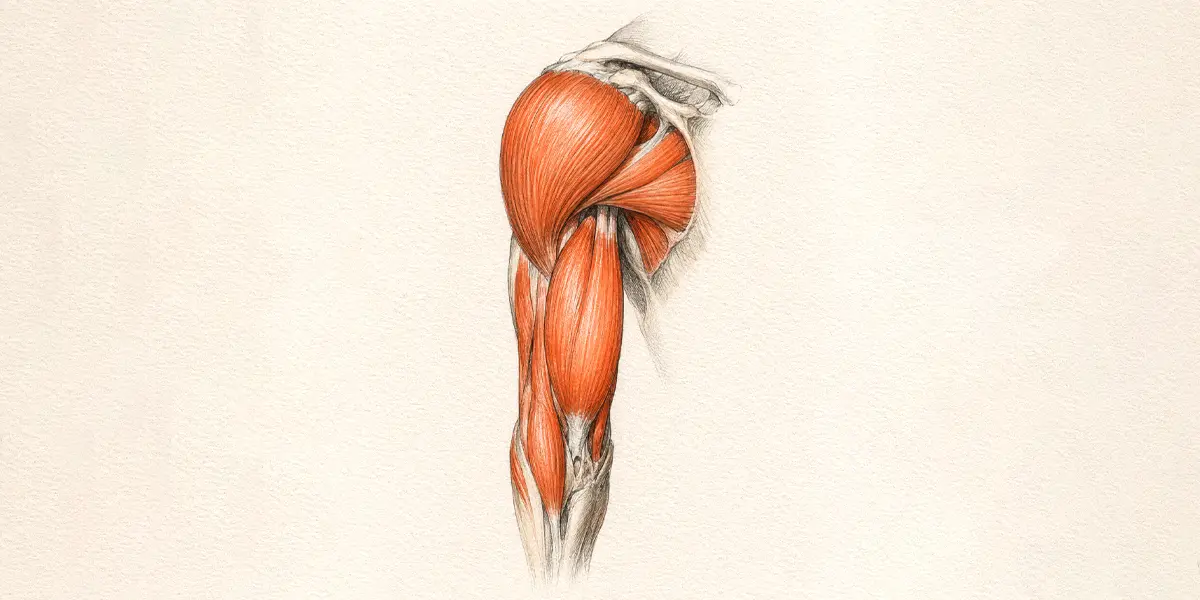
Muscle mass at any given time is a product of two competing forces: Anabolism, or muscle protein synthesis (MPS) and Catabolism, or muscle protein breakdown (MPB). Most of the supplement conversation focuses obsessively on the anabolic side. GAIN MORE MUSCLE! EAT MORE PROTEIN!
What gets ignored is the breakdown side which can become brutal when the body is under stress.
When we’re in a caloric deficit, our body shifts toward a net catabolic state. When we’re sick, sedentary, aging, or just finished a training block, muscle protein breakdown accelerates sharply. The ubiquitin-proteasome system(another nerdy mouthful!), the body’s primary intracellular protein disposal mechanism, ramps up.
Specialized enzymes called MuRF-1 and atrogin-1 tag muscle proteins for degradation, caspase proteases begin breaking down myonuclei through apoptosis. Short for: the muscle is being eaten from the inside.
You can try to out-synthesize this through aggressive nutrition, but there’s a ceiling. Under high enough catabolic stress, that ceiling is lower than most people think.

For the nerds: Know more about HMB here. (https://link.springer.com/article/10.1186/1550-2783-10-6)
The Breakdown
Let’s look at the most directly relevant data point. An acute comparison study where HMB was put against leucine found that leucine outperformed HMB on muscle protein synthesis (no surprise there!). But HMB slowed muscle protein breakdown by 57%1. That’s not a modest effect at all!
This is the crux of my argument. HMB is not an anabolic, but rather an amazing anti-catabolic supplement.
When & Where HMB’s Anti-Catabolic Effects Matter
Specificity becomes critical here.
HMB’s value is context-dependent, and understanding that context is the difference between a pseudo-supplement and the one that should have a place in our stack.
Early Training and Eccentric-Heavy Loading
HMB is strongest in one specific side: the first several weeks of a new training stimulus. When a beginner or de-trained individual begins lifting, with eccentric-heavy protocols(thank you Jeff Nippard), the muscle damage response is, no doubt, substantially higher than in conditioned athletes.
Creatine kinase (CK) and lactate dehydrogenase (LDH) levels spike, and the ubiquitin-proteasome system activates, and net muscle protein balance turns negative just for the short term.
HMB directly addresses this.
In one of these studies2, they found that 3g/day HMB during a progressive resistance training program significantly reduced CK compared to placebo, an effect that held regardless of sex or prior training status when later confirmed in a larger cohort by this other study3. Separately, this next study4 demonstrated that HMB significantly blunted both CK and LDH responses following a 20km run in trained endurance runners, suggesting the protective effect extends beyond the gym, into cardiovascular sights.
The ISSN’s 2024 updated Position Stand on HMB5 affirmed that HMB attenuates exercise-induced skeletal muscle damage across both trained and untrained populations, just one caveat. The evidence in elite resistance-trained athletes is more mixed, an essential nuance. In well-trained individuals already adapted to high training loads, the magnitude of HMB’s protective effect tends to be smaller or negligent, because the catabolic stimulus is already better managed by the adapted body.
For someone new to training, returning after a while, or beginning a phase with substantially heavier eccentric load than their recent history, HMB’s damage-reducing profile may be a meaningful tool for training consistency across those rough early weeks.
Aging and Sarcopenia
HMB’s evidence base is deepest and the most consistent in this demographic. Sarcopenia (age-related loss of skeletal muscle mass and function) is driven in large part by a chronic upregulation of the same catabolic pathways HMB targets, our body creates a progressively harder environment for us to maintain lean mass.
A 2024 systematic review and meta-analysis6, which covered five RCTs in 257 elderly sarcopenic patients, found that exercise combined with HMB supplementation significantly improved gait speed compared to exercise with placebo alone.
A separate 2024 meta-analysis7 found statistically significant improvement in handgrip strength in sarcopenic patients supplementing with HMB
A broader 2025 meta-analysis8 pooling 21 RCTs across 1,935 adults over 50 found meaningful improvements in both lean mass and grip strength, with effects most visible at 3g/day for durations above 12 weeks.
Importantly, these improvements occur in a population where they keep losing muscle mass without appropriate intervention.
In the context of sarcopenia, HMB is the right tool for the job.
Immobilization and Disuse
HMB’s most underappreciated, most mechanistically clean one is its clinical application. Bed rest, post-surgical recovery, illness, and injury all activate the ubiquitin-proteasome system aggressively. This match between the problem and the mechanism is right there.
One of the pieces of evidence for HMB comes from this randomized, controlled, double-blind trial9.
Twenty-four healthy older adults were confined to complete bed rest for ten days. Those supplementing with 3g/day HMB preserved total lean and leg lean mass significantly better than the placebo group, which lost measurable muscle across both departments. The authors concluded that HMB supplementation “preserves muscle mass during 10 days of bed rest” in healthy older adults.
To Be Noted: this was a relatively small trial (n=24) and the researchers acknowledged the need for confirmation in a larger study.
But, the mechanistic logic is supported and the directional finding is consistent with HMB’s known catabolic suppression profile.
The literature adds two further pieces of evidence that speak directly to the same underlying mechanism. Both randomized, double-blind, placebo-controlled trials using the same HMB/arginine/glutamine mixture at 3g HMB daily.
In the first study10, they tested HMB in 68 HIV-positive patients with documented AIDS-associated muscle wasting, and this second study11 extended the investigation into cancer cachexia in patients with solid tumors who had lost at least 5% of body weight.
We saw the same result: Subjects receiving the HMB-containing stack gained lean mass while the control subjects lost it.
The important caveat: HMB was not administered alone, so its individual contribution cannot be fully separated from arginine and glutamine in the mixture.
Although, what they have demonstrated is that a HMB-containing anti-catabolic stack can meaningfully reduce the amount of lean mass loss under conditions of severe, sustained catabolism.
For anyone who’s facing a forced period of inactivity, be it surgery recovery, injury, or extended illnesses, we see that HMB has an evidence-backed mechanistic rationale that few other supplements can claim in this specific context.

Who Should Bother
If you’re a well-trained athlete in a caloric surplus consuming ample protein, the honest answer is that HMB probably won’t move the needle much for you. Your anabolic signaling is already reliable, and your catabolic pathways are well-managed.
But if you’re in any of these situations:
Dieting aggressively, returning to training after a layoff, aging and trying to hold onto muscle, injured and immobile, maybe entering a brutal training block, HMB can help you here. These are the conditions where the ubiquitin-proteasome pathway is amped, where suppressing breakdown is the smarter choice.
My 2 Cents
If someone is marketing HMB as a muscle gainer, or as an anabolic agent, they are probably in the business of… catabolising your wallet.
HMB is not an anabolic supplement. It never was.
That argument is settled, but it’s also a wrong one.
HMB is in the business of preserving the muscle you have from being dismantled when your biology turns against you. Under the right conditions, like a cut, an injury, aging, early training, or prolonged high stress: it has a really useful capability.
The question was never “Can HMB build muscle?” It was always, “When your body is actively trying to eat your muscle, what can slow it down?“
On that question, HMB has a clear mechanism, and a body of evidence which is worth taking seriously.
Stop thinking of HMB as an anabolic & start using it as one of the better anti-catabolics available.
References:
1. Wilkinson DJ et al. Journal of Physiology, 2013. DOI: 10.1113/jphysiol.2013.253203
2. Nissen S et al. Journal of Applied Physiology, 1996. DOI: 10.1152/jappl.1996.81.5.2095
3. Panton et al. Nutrition, Volume 16, Issue 9, 2000, Pages 734-739, DOI: 10.1016/S0899-9007(00)00376-2.
4. Knitter AE et al. Journal of Applied Physiology, 2000. DOI: 10.1152/jappl.2000.89.4.1340
5. ISSN 2024 Updated Position Stand. Journal of the International Society of Sports Nutrition, 2024. DOI: 10.1080/15502783.2024.2434734
6. Feng Y et al. Frontiers in Nutrition, 2024. DOI: 10.3389/fnut.2024.1460133
7. Su, Hai et al. Frontiers in medicine vol. 11 1348212., DOI:10.3389/fmed.2024.1348212
8. Li et al. Frontiers in Nutrition, 2025, DOI: 10.3389/fnut.2025.1522287
9. Deutz NEP et al. Clinical Nutrition, 2013. DOI: 10.1016/j.clnu.2013.02.011
10. Clark RH et al. JPEN Journal of Parenteral and Enteral Nutrition, 2000. DOI: 10.1177/0148607100024003133
11. May PE et al. American Journal of Surgery, 2002. DOI: 10.1016/s0002-9610(02)00823-1